
Asset tokenization turns the ownership of a real-world asset into a digital token on a blockchain (a shared digital ledger). The asset, such as gold, a fund, an invoice or a property, stays with a custodian. Each token represents a share of that asset. Investors can then buy, hold and trade the tokens instantly and in small amounts. Every transfer settles on one verifiable record.
Why do companies tokenize assets?
- Smaller tickets. You can split a gold bar or a building into thousands of affordable pieces.
- Faster settlement. Trades settle in one step, not after days of back-office reconciliation.
- New investors. You can sell tokens through apps and wallets that people already use.
- Built-in compliance. Rules such as KYC (know your customer) checks, investor limits and lock-ups run automatically.
- Transparency. The record shows every holder and every transfer. The custodian gives proof of reserve, that is, evidence that the real asset covers the tokens.
What are the five steps to launch a tokenized asset?
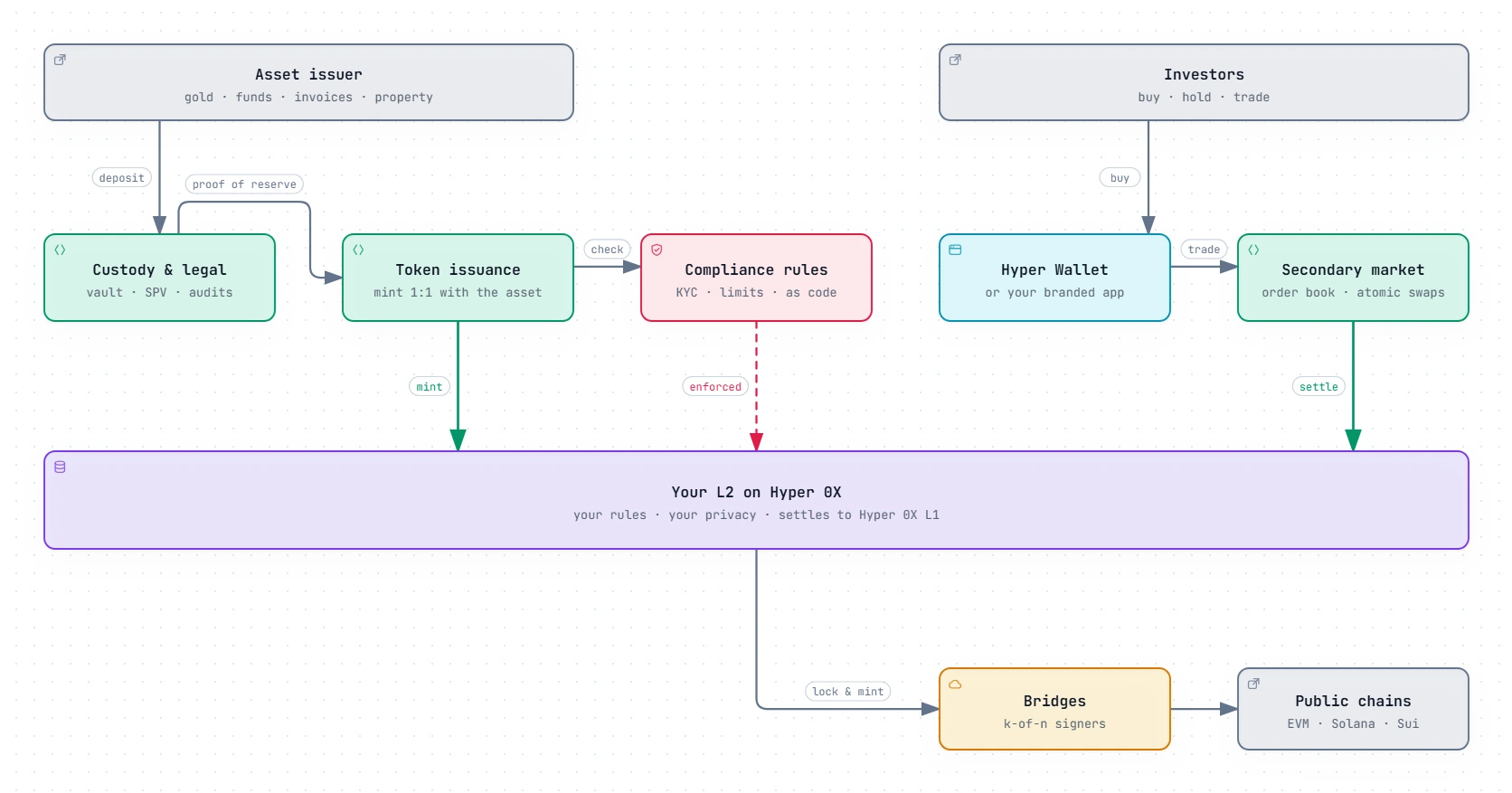
The diagram above shows the full flow on Hyper 0X, the Buckleson blockchain. Do these steps in this order:
1. Structure and custody
Choose the legal wrapper. This is often a special-purpose vehicle (SPV) or a fund. Then choose a custodian to hold the real asset. Audits and proof of reserve start at this step.
2. Issue the token
Mint (create) tokens one-to-one with the asset in custody. On Hyper 0X, you mint them on your own private L2 (a private blockchain that settles on a main chain). Because the L2 is yours, you set the rules and keep investor data private.
3. Write the compliance rules
Write KYC status, country restrictions, investor limits and maker-checker approvals as code. In a maker-checker approval, one person makes a change and a second person approves it. Hyper 0X checks these rules before a transfer executes. As a result, a non-compliant trade never happens in the first place.
4. Distribute
Investors buy through Hyper Wallet or through your own branded app. You build that app with our wallet SDKs (software development kits). Users can sign in without seed phrases (lists of backup words for a wallet) because of account abstraction.
5. Trade and settle
A secondary market lets holders trade. Trades settle atomically: both legs (the payment and the asset transfer) complete, or neither does. As a result, no one is left holding cash without the asset. Read more in atomic settlement.
Do tokens stay locked to one chain?
No. Bridges connect your L2 to public chains such as Ethereum and other EVM networks, Solana and Sui. A bridge moves tokens between two chains. Each bridge uses k-of-n signers: k of its n signers must approve a transfer. Your tokens can then reach wider liquidity when your rules allow it.
What should you watch out for?
- Custody first. A token is only as good as the asset and the custodian behind it.
- Rules before trades. If you check compliance after a trade, you must unwind the bad trades.
- Privacy. Encrypt investor records per party. Do not make them visible to every node (every computer that runs the network).
- Long-term security. Ownership records can last for decades. Use post-quantum-resistant cryptography.
How does Buckleson help?
We design the token, the private L2, the compliance rules, the wallet and the market as one system on Hyper 0X. H0X Pay is coming soon. It will let everyday users invest a slice of every payment in tokenized gold, funds and stocks. To launch your own tokenized asset, see our blockchain development services or book a call.
Architecture in detail
Frequently asked questions
What is asset tokenization?
Asset tokenization puts the ownership of a real-world asset on a blockchain as a digital token. The asset can be gold, a fund, an invoice or a property. A custodian holds the asset, and that asset backs each token.
Which assets can be tokenized?
Common examples are commodities such as gold, fund units, bonds, invoices and receivables, real estate and private company shares. You can tokenize any asset that has clear legal ownership and reliable custody.
Is tokenization legal?
Tokenization is a technology, not a legal shortcut. The asset still needs the right legal structure and licences in each market. A good platform enforces those rules as code, for example KYC checks and investor limits.
How long does it take to launch a tokenized asset?
The time depends on the legal structure and the custody. These usually take longer than the technology. The technical work can start as a pilot on a private L2 while the legal work runs in parallel.
