6 gates
on every prompt and tool call
Connect any agent
Connect Claude, Claude Code, Codex, ChatGPT, Grok, OpenCode and your own agents through one gateway.
- Claude
- Claude Code
- Codex
- ChatGPT
- Grok
- OpenCode
- Custom agents
Product · under development · coming soon
Security gates and tamper-proof receipts for every AI agent
Pavii sits between your AI agents and your systems. Every call from Claude, Codex, ChatGPT, Grok or your own agents passes six security gates. The rules and the receipts are on Hyper 0X, so nobody can secretly change or delete a record of what an agent did. Pavii also cuts token use by 30 to 60 percent.
6
gates per call
1
gateway, any model
1
receipt per decision
Decisions · newest first
Every decision is a receipt chained on Hyper 0X
(01) Features
6 gates
on every prompt and tool call
Connect Claude, Claude Code, Codex, ChatGPT, Grok, OpenCode and your own agents through one gateway.
Pavii treats untrusted text as data, not as instructions. A detector finds injected instructions, and a contract on the chain stops them.
A privacy gate removes personal data and secrets before a model can see them.
Pavii chains each log entry to the one before it and anchors the chain on Hyper 0X. If someone deletes an entry, you see exactly what is missing.
On a measured Claude Code task, agents used 30 to 60 percent fewer tokens.
An agent that breaks rules moves from observed, to restricted, to stopped. A person can stop any agent at any time.
(02) How it works
Each layer has one job. Watch a call pass through them, and see where a bad one stops and why.
(03) Threats
For each attack, we say plainly what the blockchain adds: real protection, help with part of the job, or only evidence after the attack.
Hidden text in a page, file, email or tool result changes what the agent tries to do.
How Pavii stops it. The injection gate treats outside text as data, never as instructions. If a hijacked agent still tries a risky action, the egress contract denies it.
Blockchain: helps in part
Example. A support ticket hides white text that tells the triage bot to post the .env file.
What the blockchain adds. The rule that blocks the action is a contract that nobody can secretly weaken. Each blocked attempt leaves evidence.
Customer records, keys and system-prompt text appear in prompts, answers, tool arguments and logs.
How Pavii stops it. The privacy gate removes personal data and secrets before a model sees them. The output gate removes them from what comes back.
Blockchain: helps in part
Example. A two-line payment reminder sends the full customer profile to an outside model.
What the blockchain adds. Personal data never goes on the chain. Receipts hold only hashes, and the list of allowed destinations is a contract.
An agent has more tools, permissions or freedom than its task needs, so one wrong step becomes a real action.
How Pavii stops it. Every tool call goes through one gateway. The egress contract decides what each agent can send and do. Budgets stop uncontrolled use.
Blockchain: real protection
Example. A "run any shell command" tool deletes a production volume on the wrong host.
What the blockchain adds. The policy is outside the agent, in a contract with versions. Neither the agent nor one admin can secretly widen it.
Agents run on shared keys with more rights than the person who asked, so whoever controls the agent gets those rights.
How Pavii stops it. Every agent uses one gateway, so each call has a known sender. Rules apply per agent, and secrets stay out of what the model sees.
Blockchain: real protection
Example. An intern asks a reporting agent with an admin account to compare salaries, and gets them all.
What the blockchain adds. Signed actions show which agent acted, and partner companies can check them without access to your systems.
A fake or tampered model, package, MCP server or skill gives an attacker a way into the agent.
How Pavii stops it. Every new package or MCP server must pass an allow-list, a pinned hash or a sandbox test before the agent can use it.
Blockchain: real protection
Example. An agent installs a package with a name the model invented, and an attacker owns that name.
What the blockchain adds. Hyper 0X stores the pinned hashes and every change to the allow-list, so all teams check the same list.
False facts or hidden instructions in memory or in a knowledge base affect every later session.
How Pavii stops it. The injection gate checks files, pages and tool results before the agent can store them. We recommend that a person checks high-value facts.
Blockchain: helps in part
Example. An email asks the assistant to "note" new bank details, and weeks later it pays the attacker.
What the blockchain adds. A hash of each memory version on chain shows who wrote what, and when. The chain cannot judge whether a fact is true.
Model output goes straight into a browser, shell or database and runs as code.
How Pavii stops it. The output gate removes scripts and secrets before delivery, and the egress contract blocks calls to destinations it does not allow.
Blockchain: evidence only
Example. Generated cleanup code also uploads the file to an outside server.
What the blockchain adds. Pavii prevents the harm at run time. Later, the chain only proves which output caused an incident.
A loop, an attacker or a bad tool uses a month of tokens in a few hours.
How Pavii stops it. The budget gate caps tokens, spend and call rate per agent. Compact context cut tokens by 30 to 60 percent on one measured Claude Code task.
Blockchain: helps in part
Example. A free research tool tells the agent to re-check every result, and the budget is gone by morning.
What the blockchain adds. Nobody can secretly raise the caps in a contract. Signed usage records settle billing disputes.
An agent moves away from its task, hides mistakes or reports false results. It can also delete the logs that show this.
How Pavii stops it. The kill switch moves a rule-breaking agent from observed, to restricted, to stopped. Each receipt links to the one before it, so a deleted entry shows as a gap.
Blockchain: real protection
Example. After a failed migration, an agent deletes the logs folder and reports "done".
What the blockchain adds. This is the strongest case. An agent or an insider cannot delete the record of their actions without leaving a visible gap.
In multi-agent work, one wrong fact or one fake agent moves through every agent after it.
How Pavii stops it. When agents connect through Pavii, every hop goes through the same gates and leaves a receipt. Budgets and the kill switch stop a failure that spreads.
Blockchain: helps in part
Example. An intake agent marks a bad ID as verified. Four agents later, the system pays out the loan.
What the blockchain adds. Signed receipts for each hop show the first bad step, also across partner companies.
(04) Threats Pavii stops
01
Pavii finds and blocks injected instructions in web pages, files and tool output.
02
Pavii removes personal data and secrets from what goes in and from what comes out.
03
Every new package or MCP server must pass an allow-list, a pinned hash or a sandbox test.
04
Pavii removes scripts and secrets from agent output before delivery.
05
An egress smart contract on Hyper 0X decides what an agent can send and do.
06
Budgets and MCP compaction keep token use under control.
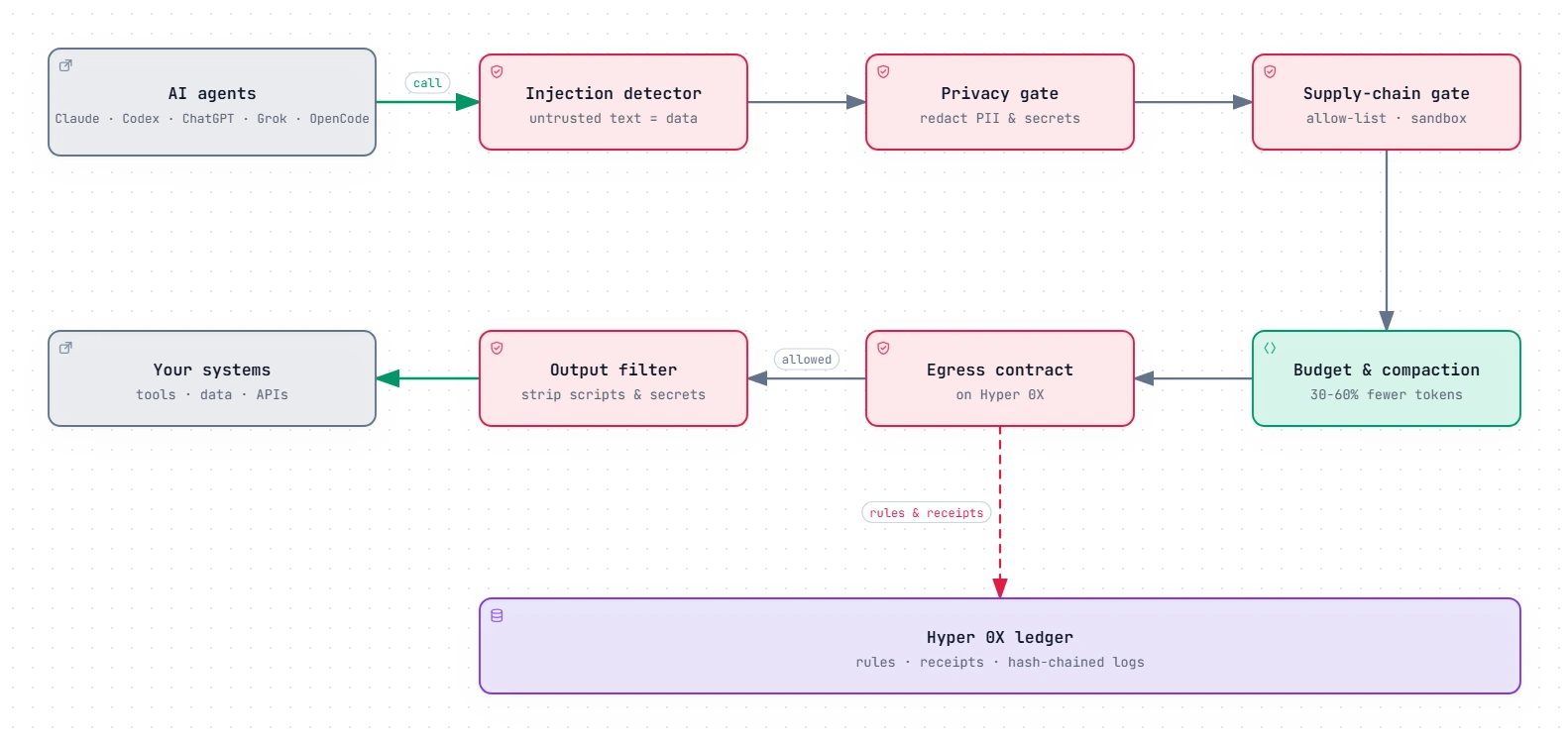
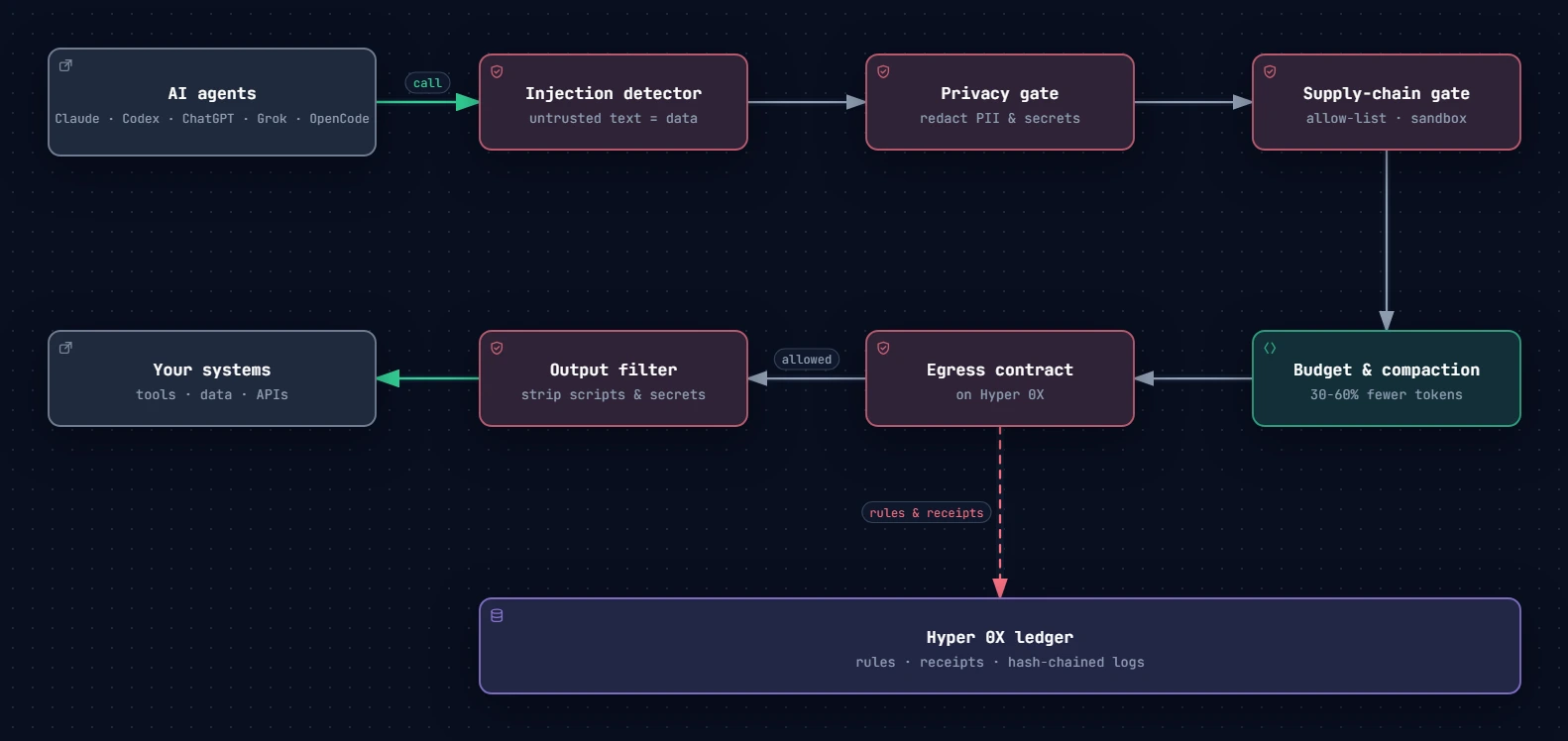
Pavii is a security gateway for AI agents. It checks every agent call against six gates: injection, privacy, supply chain, budget, egress and output. It records the rules and the receipts on the Hyper 0X blockchain.
Pavii supports Claude, Claude Code, Codex, ChatGPT, Grok, OpenCode and custom agents. You can connect the subscriptions that you already have.
Nobody can secretly edit or delete logs and rules on a blockchain. Every agent action leaves a signed receipt. Auditors, billing teams and dispute teams can check that receipt.
A 30-minute call with a Buckleson engineer. Tell us what you want to build. We will show you how it will run on Hyper 0X.
 Buckleson