
A good blockchain development company does more than write smart contracts (programs that run on a blockchain). It owns the whole path from idea to production. That path covers the chain that your product runs on, the security model and the integrations with your existing systems. It also covers the people who keep it running. Choose one that can show you a live system and explain its architecture in plain words. The right company also starts with a small, measurable pilot.
What should a blockchain development company deliver?
Most projects need the same five building blocks. Ask any partner how they handle each one.
- The chain. The chain is where your transactions settle. It can be a public network, a private network, or a private L2 (a private layer) that settles to a shared L1 (a main chain).
- Smart contracts and rules. These hold the business logic: who can do what, limits, approvals and compliance checks.
- Assets and accounts. This covers tokens, tokenized real-world assets, wallets and how users sign in.
- Integrations. This covers bridges (links that move tokens) to other chains. It also covers connections to core banking, ERP (enterprise resource planning) and payment systems.
- Operations. This covers monitoring, upgrades, key management and incident response.
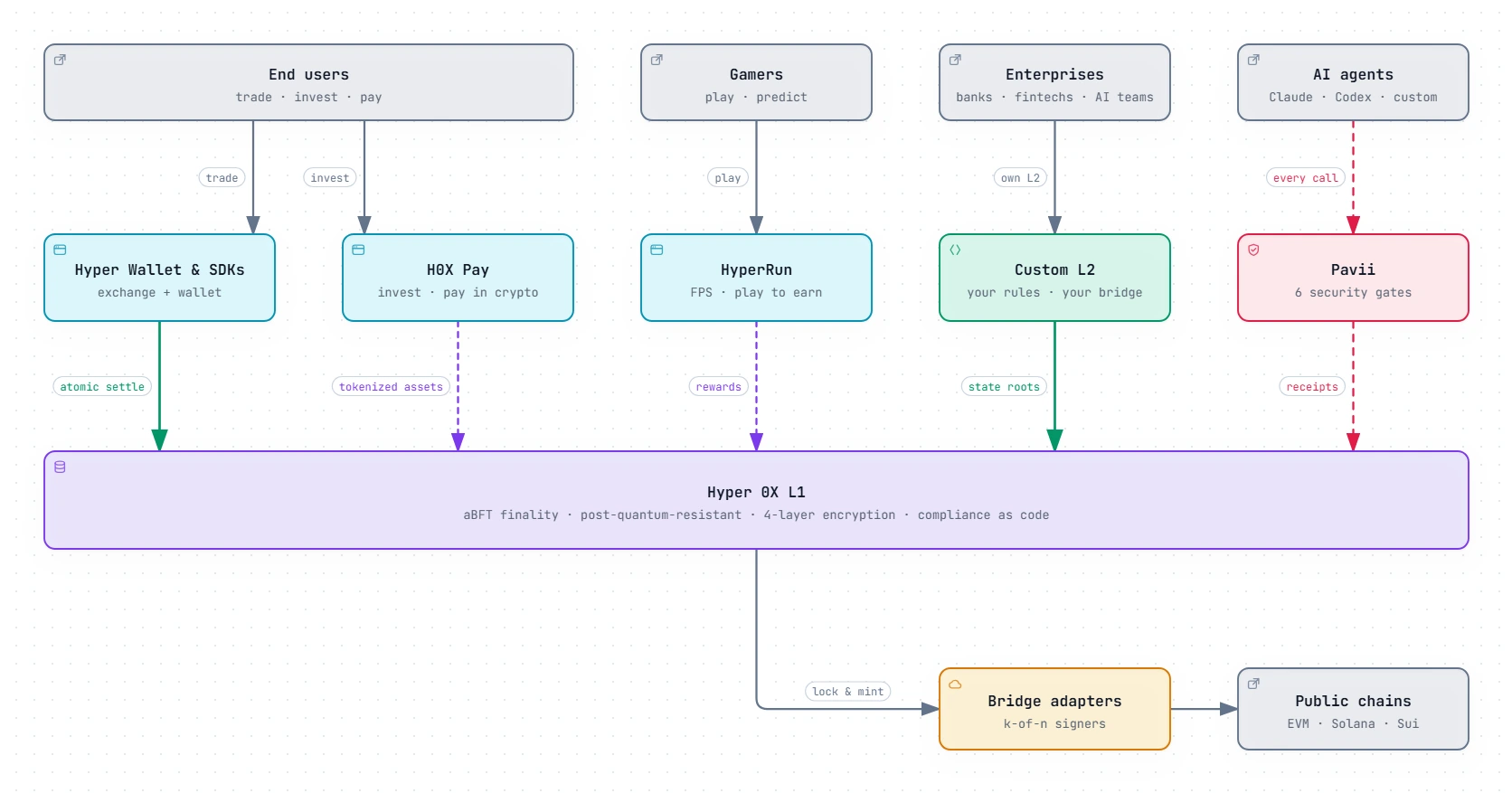
At Buckleson we deliver all five on Hyper 0X, the blockchain we built ourselves. The diagram above shows how our own products and customer chains share it.
Which questions should you ask before hiring?
- Do you run anything in production today? Ask for real numbers.
- Who controls the chain? If the partner builds on someone else’s network, you inherit its fees, roadmap and outages.
- How are transactions finalised? Look for deterministic finality. This means no reorgs (rewrites of recent blocks), and no chance that anyone reverses a confirmed payment.
- How do you handle privacy? Regulated data must stay encrypted per party, not just hidden behind a login.
- Is the cryptography ready for the long term? Records that must stay private for decades need post-quantum-resistant key exchange (the way two parties agree on a secret key).
- How do compliance rules work? The best answer is “as code, before the transaction executes”, not “we check later”.
What are the red flags?
- A token sale pitched before the use case is clear.
- No answer on who runs the validators (the computers that confirm transactions).
- Promises of unlimited speed with no explanation of the trade-offs.
- A full rebuild every time you add a feature, because the core is not modular.
- No plan for keys: who holds them, where, and what happens if someone loses one.
Public chain, private chain or private L2?
There is no single right answer. Public chains suit open products that anyone can use. Private chains suit closed consortiums. Many enterprises want both: privacy and their own rules, plus a way to reach public liquidity. A private L2 on a shared L1 gives you that. We compare the options in private L2 vs public blockchain.
How does Buckleson work?
We are a blockchain infrastructure company. We built Hyper 0X, and we build on it every day. This work covers Pavii for AI-agent security, Hyper Wallet for trading and payments, and custom L2s for banks, fintechs and asset issuers. Every engagement starts with a scoped pilot, a forward-deployed engineer (one who works inside your team) and success metrics agreed up front. See our blockchain development services or book a call to talk through your use case.
Architecture in detail
Frequently asked questions
What does a blockchain development company do?
It designs, builds and runs blockchain systems for a business. These include private or public chains, smart contracts, tokenized assets, wallets and exchanges. They also include the integrations that connect them to existing systems.
Should I build on a public chain or a private one?
Public chains suit open, permissionless products that anyone can join. Regulated businesses that need privacy, known validators and predictable fees usually do better with a private L2 that can still bridge to public chains.
How long does a blockchain pilot take?
It depends on scope. A good partner starts with one use case, agrees success metrics up front, and only then expands to production.
