
For most enterprises, the best answer is a private L2: your own blockchain layer with your own rules and privacy. It settles to a shared L1, the main chain that keeps the final record. When you need public chains, bridges (links that move assets between chains) connect it to them. Public blockchains are good for open products. But they expose data to everyone, and they leave you with someone else’s fees and roadmap.
What is the difference?
| Topic | Public blockchain | Private chain | Private L2 on Hyper 0X |
|---|---|---|---|
| Who can validate | Anyone | Your consortium | Known, PKI-bound validators |
| Who can see data | Everyone | Members | Only the parties to each record |
| Your own rules | No | Yes | Yes, as code |
| Shared record with others | Yes | No | Yes, through the L1 |
| Reach public liquidity | Native | Hard | Bridges to EVM, Solana, Sui |
| Fees and roadmap | Set by the network | Yours | Yours, on a chain built for it |
When does a public blockchain make sense?
Choose a public chain when your data can be public and anyone in the world can use your product without permission. Examples include open DeFi protocols and community tokens.
When does a private chain make sense?
A standalone private chain fits a closed group that never needs to work with anyone else. The downside is isolation: there is no shared record with partners, and you must build every integration from scratch.
Why a private L2 is often the best of both
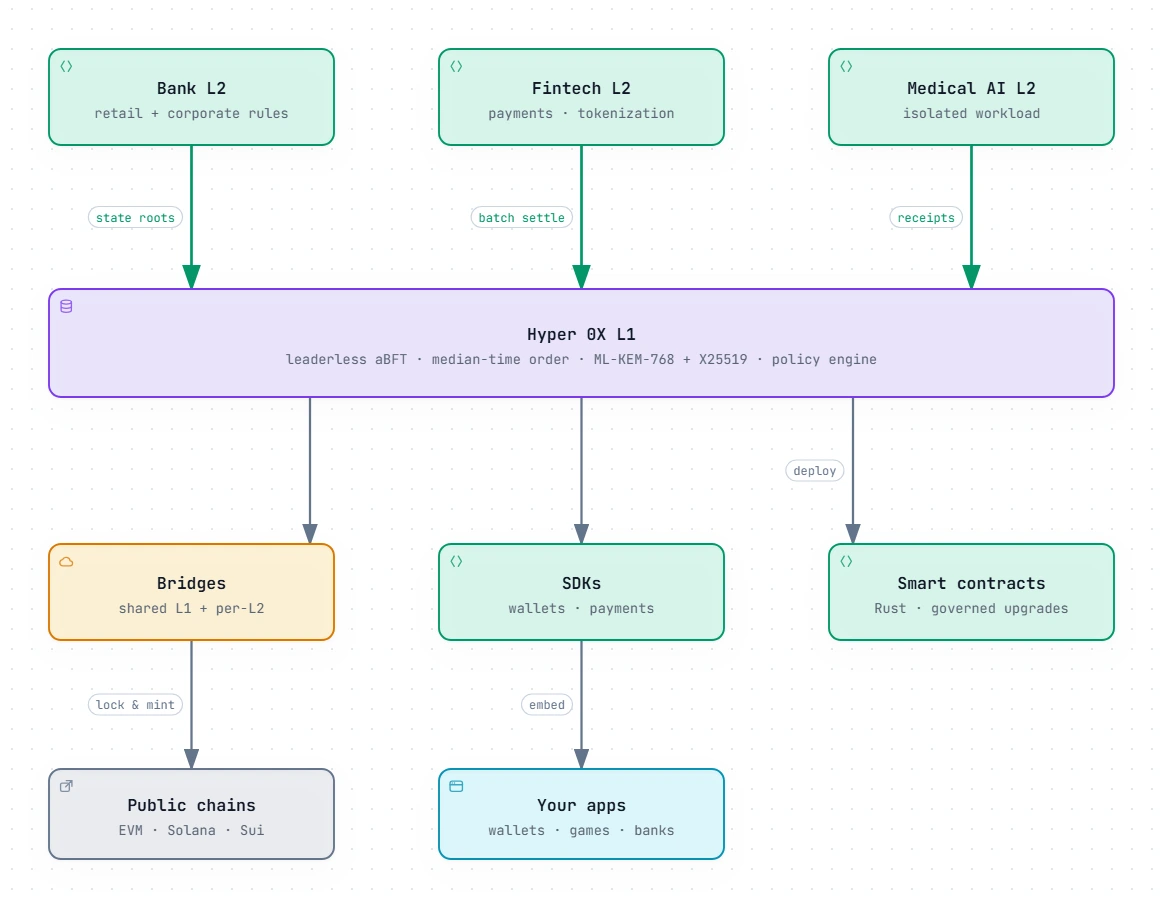
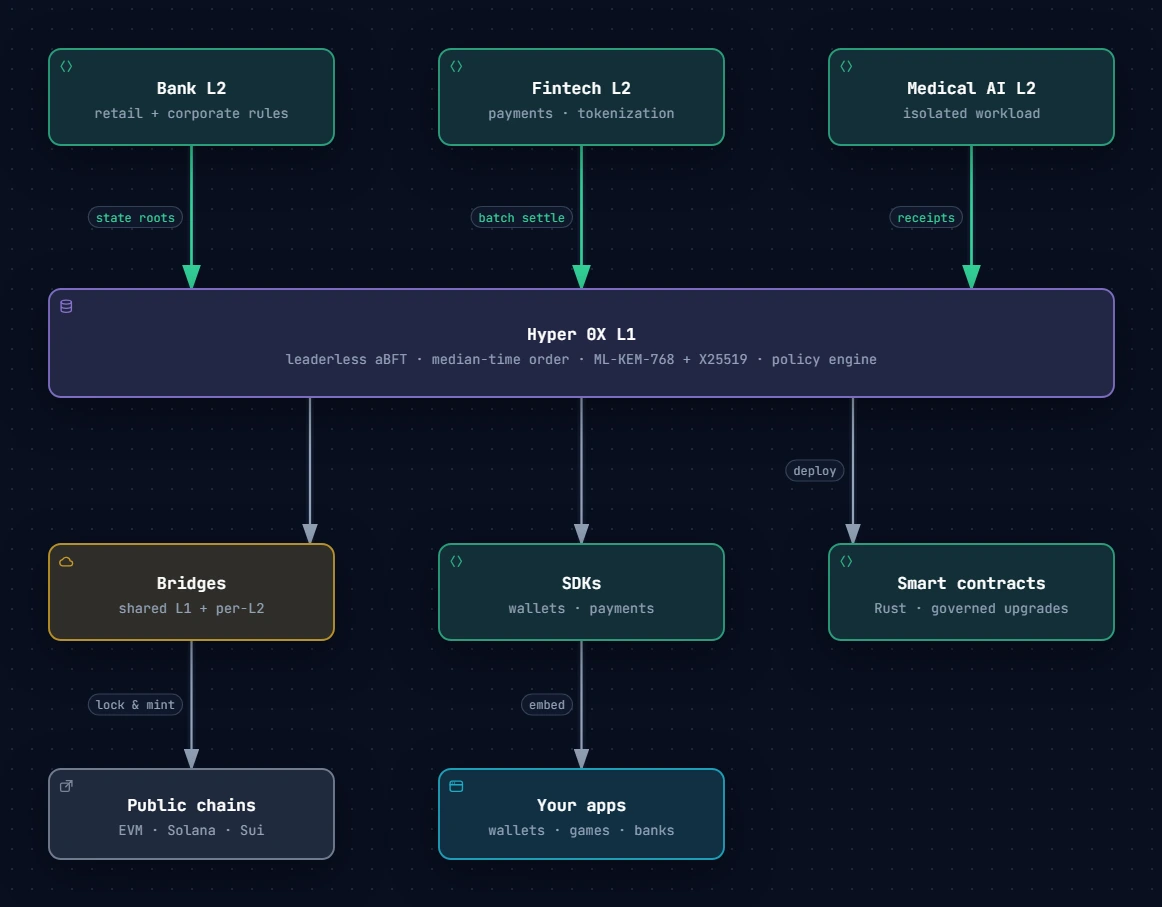
A private L2 gives each organisation its own sequencer (the component that orders transactions), policies, privacy and bridge. So a payroll peak at one bank never slows another bank. Every L2 settles its state roots (short fingerprints of its records) to the shared Hyper 0X L1. So partners can check the same record, but they do not see each other’s private data. This is the model behind Hyper 0X, which the diagram above shows.
What else should you compare?
- Finality. Hyper 0X uses leaderless aBFT consensus, a voting method with no single leader. A confirmed transaction is final in one pass, and nobody can reverse it. There are no reorgs (replacements of recent blocks).
- Ordering. Transaction order comes from the median time at which validators received each transaction. So no single node can front-run (put its own transaction first).
- Encryption. Hyper 0X protects data in transit, in computation, on the ledger and at rest. Its key exchange is post-quantum-resistant.
- Scaling. Blocks grow with demand on each L2. See dynamic blocks.
- User experience. Account abstraction makes each account a smart contract with its own rules. It removes seed phrases and gas tokens.
How to decide
Start with your data. If it must stay private or regulation applies to it, rule out a bare public chain. Then ask if you need a shared record with partners or public liquidity. If yes, a private L2 is the natural fit. Buckleson can set one up for you as a pilot. See how to choose a blockchain development company for what to expect.
Architecture in detail
Frequently asked questions
What is a private L2?
A private L2 is a blockchain layer dedicated to one organisation. It has its own rules, privacy and validators. It periodically settles its state to a shared L1, the main chain, so it gets both independence and a common record.
Is a public blockchain safe for enterprise data?
Public chains are secure for open data, but every node can see the transactions. Sensitive business data usually needs per-party encryption and known validators. A private L2 gives both.
Can a private L2 connect to Ethereum or Solana?
Yes. On Hyper 0X, every L2 can use bridge adapters to reach EVM chains, Solana and Sui when its rules allow.
