
A multi-chain crypto wallet is one app that manages keys, addresses and transactions for many blockchains at once. It derives a separate key and address for each chain. Examples are Bitcoin, Ethereum and other EVM chains (chains that run Ethereum-style smart contracts), Solana, Tron, TON, XRP, Stellar and Sui. The wallet also uses the transaction format of each chain. Swaps and bridges then let users move value between those chains without leaving the app.
Why do people need a multi-chain wallet?
Money does not live on one blockchain. A freelancer can get paid in USDT (a dollar stablecoin) on Tron, save in Bitcoin and use apps on Ethereum or Solana. With single-chain wallets, that person juggles several apps, several backups and several fee tokens. One wallet replaces all of that with one place to see, swap and send.
Consider a remittance fintech whose customers receive USDT on Tron but want to hold USDC (another dollar stablecoin) on Ethereum. Without a multi-chain wallet, each customer needs two wallets, an exchange account and the patience to move funds between them. With one, they swap inside the app and see a single balance.
How can one wallet hold keys for many chains?
Most multi-chain wallets start from one master secret and derive a separate key for each chain. The common recipe comes from Bitcoin standards. BIP-32 defines hierarchical deterministic (HD) wallets, where one root key produces a tree of child keys. BIP-44 gives each chain its own branch of that tree, called a derivation path. SLIP-10 extends the same idea to chains that use Ed25519 keys, such as Solana and Stellar.
Chains also use different cryptography (the math behind keys and signatures). Bitcoin, Ethereum and Tron sign with the secp256k1 curve. Solana, Stellar and TON use Ed25519. The XRP Ledger supports both, and Sui supports several schemes, including secp256r1, the curve behind passkeys.
The way chains keep track of money differs too:
- Unspent outputs. Bitcoin and its cousins, such as Litecoin, Bitcoin Cash and Dash, track coins as unspent transaction outputs (UTXOs), like notes in a purse.
- Accounts. Ethereum, Tron, Solana, XRP and Stellar track balances per account, like a bank account.
- Objects and contracts. Sui stores assets as objects with owners. On TON, every account, including a wallet, is a smart contract (a program on the chain).
A multi-chain wallet must handle all of these models and still show users one simple balance.
Why does every chain have a different address format?
An address is a public identifier derived from a key and encoded to suit its chain. The formats differ, and so do the mistakes they invite.
| Chain | What an address looks like | Watch out for |
|---|---|---|
| Bitcoin | Starts with 1, 3 or bc1 | Several types. A fresh address per payment helps privacy |
| Ethereum and EVM chains | 0x plus 40 hex characters | Same address on every EVM chain, so the selected chain must match |
| Solana | 32 to 44 base58 characters | A new token needs a token account funded with a little SOL |
| Tron | Starts with T, 34 characters | Fees use bandwidth and energy, from staked or burned TRX |
| TON | 48 characters, often starting EQ or UQ | Bounceable and non-bounceable forms. Comments for exchanges |
| XRP Ledger | Starts with r | Destination tags for exchanges. A reserve to activate accounts |
| Stellar | Starts with G, 56 characters | Memos for exchanges. A minimum balance and trustlines |
| Sui | 0x plus 64 hex characters | Looks like EVM but is not interchangeable |
The safest wallets do these checks for users. They validate every address against the selected chain and warn when a memo or tag is missing. They also fill in addresses automatically where they can. Hyper Wallet, for example, lets users deposit from Binance or Coinbase on any coin page with their address filled in for them.
How do bridges and swaps move value between chains?
There are two ways to move value across chains, and they carry different risks.
A bridge moves an asset from one chain to another. The most common design locks the original asset in a contract on the first chain and mints (creates) a wrapped copy on the second. The wrapped copy is a token that stands for the locked asset. Some stablecoin issuers instead burn (destroy) tokens on one chain and mint them natively on another. Bridges hold large pools of locked assets, which makes them targets. The Ronin and Wormhole bridge hacks in 2022 each cost hundreds of millions of dollars.
A swap exchanges one asset for another. On a single chain, a router finds the best price across the available liquidity. Across chains, the safest designs first lock both legs (the two sides of the trade). Then they complete both legs or refund both, so nobody holds only one leg. The classic technique is the hash time-locked contract (HTLC). It pays out only if the receiver reveals a secret that matches a published hash before a deadline, and otherwise refunds the sender.
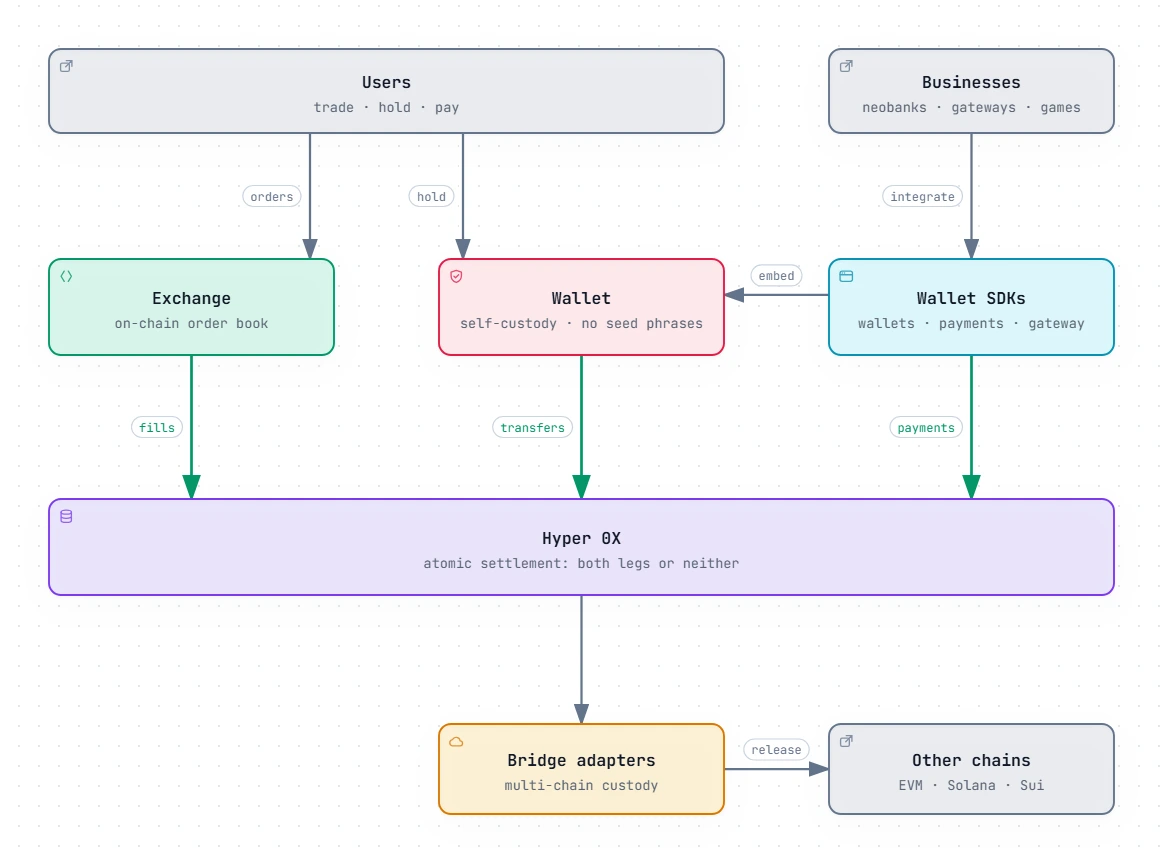
This is the idea behind atomic settlement: both legs or neither. In Hyper Wallet, users swap from any coin page at the best route. The swaps use MEV-protected transactions and settle atomically on Hyper 0X, our blockchain. MEV is profit that bots take by reordering or front-running trades. Hyper 0X bridge adapters connect to EVM chains, Solana and Sui.
What are the security trade-offs?
More chains are convenient, but every new chain widens the surface to defend. The main trade-offs:
- One secret, many chains. A single master secret is easy to back up. But if it leaks, the leak exposes every chain at once. Protect keys with the secure hardware of the device. Favor recovery methods that do not rely on users writing down words.
- More code paths. Each chain has its own signing, fee and transaction logic. Each needs its own tests and security review. A bug on one chain must never touch the others.
- Wrapped assets carry bridge risk. A wrapped token is only as safe as the bridge behind it. So show users clearly whether an asset is native or wrapped.
- Chain-specific scams. On EVM chains, unlimited token approvals (permissions for a contract to spend a token) let a malicious or compromised contract drain that token later. In address poisoning, attackers send tiny transfers from look-alike addresses. This tricks people into copying the wrong address from their history. Good wallets warn about both.
- Fees in many tokens. Every chain has its own fee token. Users get stuck when they hold an asset but not the gas (the fee token) to move it. Where the chain supports it, account abstraction lets an app pay fees for its users. See account abstraction without seed phrases.
Non-custodial design limits the damage of a provider breach, because keys never leave users’ devices. Hyper Wallet uses that model across Bitcoin, Litecoin, Bitcoin Cash, Dash, Ethereum and other EVM chains, Solana, Tron, TON, XRP, Stellar and Sui. For more on that choice, see custodial vs non-custodial wallets.
Where should you start?
- List the chains and assets your users already hold, and start there.
- Decide which assets you will support natively and which only through bridges.
- Test every chain’s quirks: memos, tags, reserves, token accounts and fee tokens.
- Build address checks and clear warnings into every send screen.
- Choose an SDK that already supports your chains in production. See what a wallet SDK is.
Hyper Wallet and its SDKs give you these chains in one non-custodial wallet, with swaps that settle atomically on Hyper 0X. Our wallets and exchanges team can tailor it to your product. Book a call to plan your chain list.
Architecture in detail
Frequently asked questions
Can I use the same address on every blockchain?
Only within one family. The same 0x address works across Ethereum and other EVM chains, but Bitcoin, Solana, Tron, TON, XRP, Stellar and Sui each use their own format. A multi-chain wallet shows the right address for each chain.
What happens if I send crypto on the wrong network?
It depends on who controls the address. If your own wallet controls the same address on that network, you can usually recover the funds. If the address belongs to an exchange that does not support that network, recovery can be slow or impossible. Always match the network on both sides.
Is a multi-chain wallet less secure than a single-chain wallet?
Not by default, but it has more to defend. More chains mean more code to audit and more chain-specific mistakes to prevent. Strong key storage on the device, careful testing of every chain and clear warnings matter more than the number of chains.
